| A Boutique Commercial Mortgage Brokerage, Dedicated to
Exceptional Service and Proven Results | |
Capital Markets Report | |
| | US Treasury Yield Curve
Month over Month Comparison |
|
|
|
|
|
|
In The News
|
|
Commercial Interest Rates and Bond Market Update
Week Ending June 12, 2026 Federal Reserve Policy
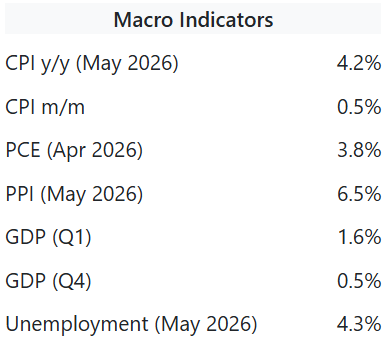
- The next FOMC meeting is June 16 to 17, Kevin Warsh's first as Fed Chair; markets widely expect rates held at 3.50% to 3.75%, with the updated dot plot and SEP set to signal the rate path forward.
- May CPI rose 4.2% year over year, a three-year high, while May PPI surged 6.5% year over year, the highest since November 2022, driven by Middle East energy-shock pass-through and sticky services inflation.
- April FOMC minutes revealed most officials favor policy firming if inflation stays persistently above 2%; PCE data due June 25 will be the next critical inflation read ahead of the July meeting.
Bond Market Trends
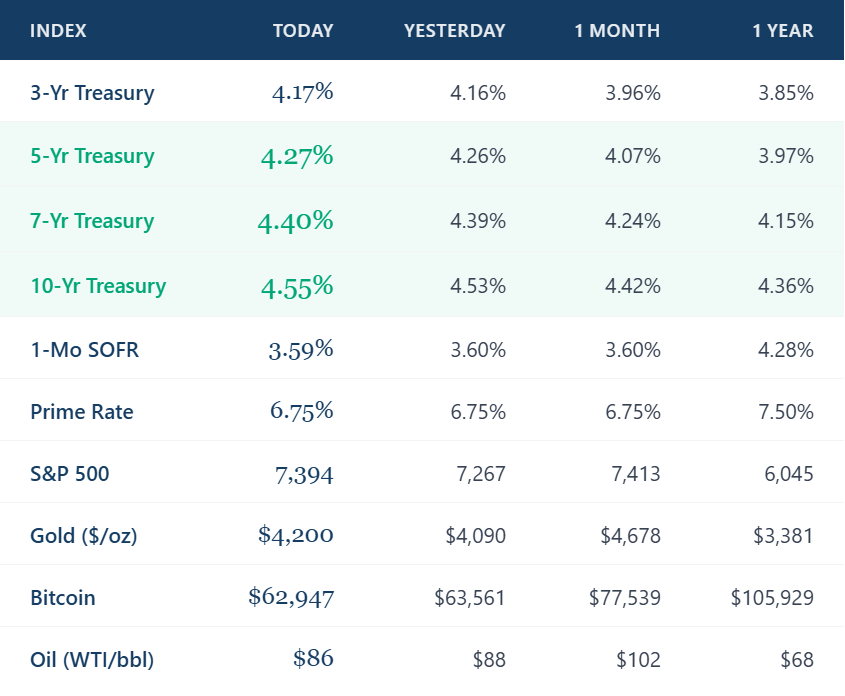
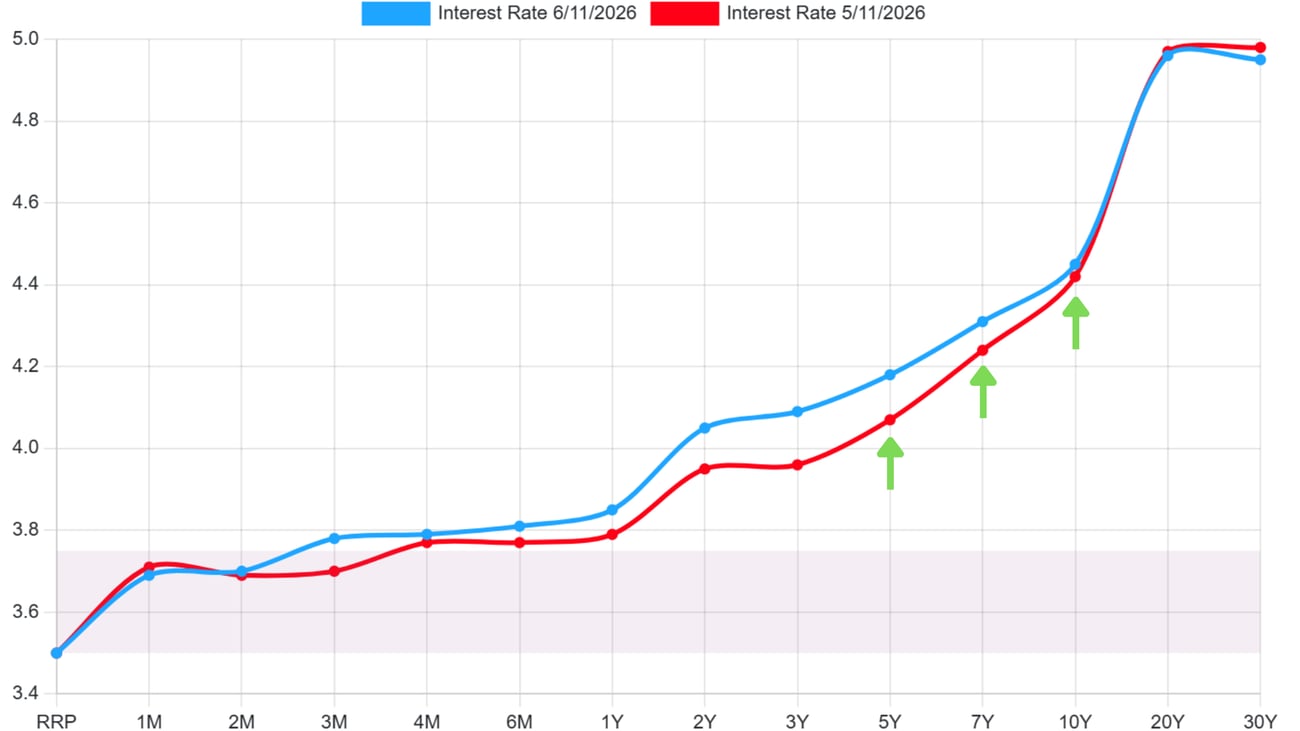
- The yield curve steepened sharply month over month: the 5Y rose from 4.07% to 4.18% (up 11 bps), the 7Y climbed from 4.24% to 4.31% (up 7 bps), and the 10Y moved from 4.42% to 4.45% (up 3 bps), reflecting persistent inflation fears and geopolitical risk premiums building in long-end Treasuries.
- Escalating Middle East tensions, including threats to Iran's Kharg Island oil terminal, combined with hotter-than-expected CPI and PPI prints drove long-end yields higher as energy-driven inflation expectations increased.
- Despite long-end pressure, short-term rates from RRP through 6M remained anchored near 3.50% to 3.80%, reflecting continued market confidence that the Fed holds near-term, with rate hike risk concentrated in Q4 2026.
Commercial Interest Rates - Agency loans (Fannie/Freddie) are pricing 5.63% to 6.03% depending on loan size; FHA/HUD non-recourse financing is available from 5.42% with up to 80% LTV for qualifying multifamily assets in major markets.
- Bridge and construction financing ranges 7.50% to 10.00%+; lenders are tightening underwriting on new development amid rising costs, softening exit caps, and a growing CRE maturity wall peaking at $1.26T in 2027.
- CMBS loans pricing at 6.56%; SBA 504 near 5.88%; life company lenders remain most competitive for stabilized Class A assets at 5.50% to 6.00%, with spreads tightest on grocery-anchored retail and industrial.
Takeaway: With the June FOMC meeting days away and inflation running at multi-year highs, the rate environment remains elevated and volatile. Borrowers with near-term maturities should engage lenders now, as new Fed Chair Warsh is more likely to hold or hike than cut, keeping long-term commercial borrowing costs elevated through year-end.
LA Commercial Real Estate Market TrendsWeek Ending June 12, 2026 Multifamily
- Onni Group pivoted its Miracle Mile project from office to residential, reflecting accelerating conversion momentum across LA's supply-constrained submarkets as persistent housing demand continues to drive adaptive reuse.
- Measure ULA carve-outs are under City review; a report found they could reduce transfer tax revenue by up to 35% annually, potentially unlocking deal velocity for transactions above the $5.3M threshold.
- LA multifamily investors are shifting from ground-up construction to preservation plays; with financing costs elevated and new supply muted, value-add acquisition of Class B/C vintage assets offers stronger risk-adjusted returns.
Retail - Redwood West and Panattoni JV acquired Victoria Gardens Mall for $530M, one of the largest retail trades in Southern California in 2026, signaling continued institutional appetite for dominant, experiential retail assets.
- Cedars-Sinai Medical Center acquired the Beverly Connection shopping center adjacent to its campus, reflecting healthcare-driven retail conversions as medical tenants increasingly absorb former anchor spaces.
- Necessity-based and service retail continues to outperform; mid-market inline tenants face selective rent reductions, while grocery-anchored and medical-use retail commands cap rates in the 5.50% to 6.25% range.
Industrial - Amazon signed a 615K SF infill warehouse lease in LA County, driving significant positive net absorption in the Central LA submarket and signaling renewed institutional demand for last-mile logistics near dense urban cores.
- The Wonderful Logistics Center is transforming California's Central Valley with a large-scale distribution hub; investor interest in port-proximate industrial remains strong despite slight softening in secondary submarkets.
- LA industrial vacancy remains near 3.8%, among the tightest nationally; sale pricing averaging $384 per SF with cap rates at 5.00% to 5.30%; AB 98 regulatory headwinds are slowing speculative new construction starts.
Office - Jamison Services secured $195M to convert a DTLA office tower to residential; adaptive reuse under LA's Expanded ARO is now the primary absorption mechanism for a market carrying 31%+ vacancy.
- A Westwood office asset traded at $38.2M while a Burbank CMBS loan backed by a Blackstone/Worthe property moved to special servicing, highlighting continued bifurcation between well-located and distressed office.
- Flight-to-quality dominates leasing; Angel City Football Club's renewal at Media Park Santa Monica and a 50K SF lease at a top West Side property show well-amenitized, transit-adjacent assets remain competitive.
LA Market Takeaway: The LA CRE market in June 2026 is defined by sharp divergence: industrial and multifamily fundamentals remain resilient while office navigates structural distress through adaptive reuse and selective trades. With Treasury yields elevated and the Fed meeting next week, execution speed and lender relationships are increasingly decisive for borrowers navigating a volatile rate environment. |
|
|
| A Lesson Beyond Brokerage
| |
The US Leads the World in Aluminum Recycling
|
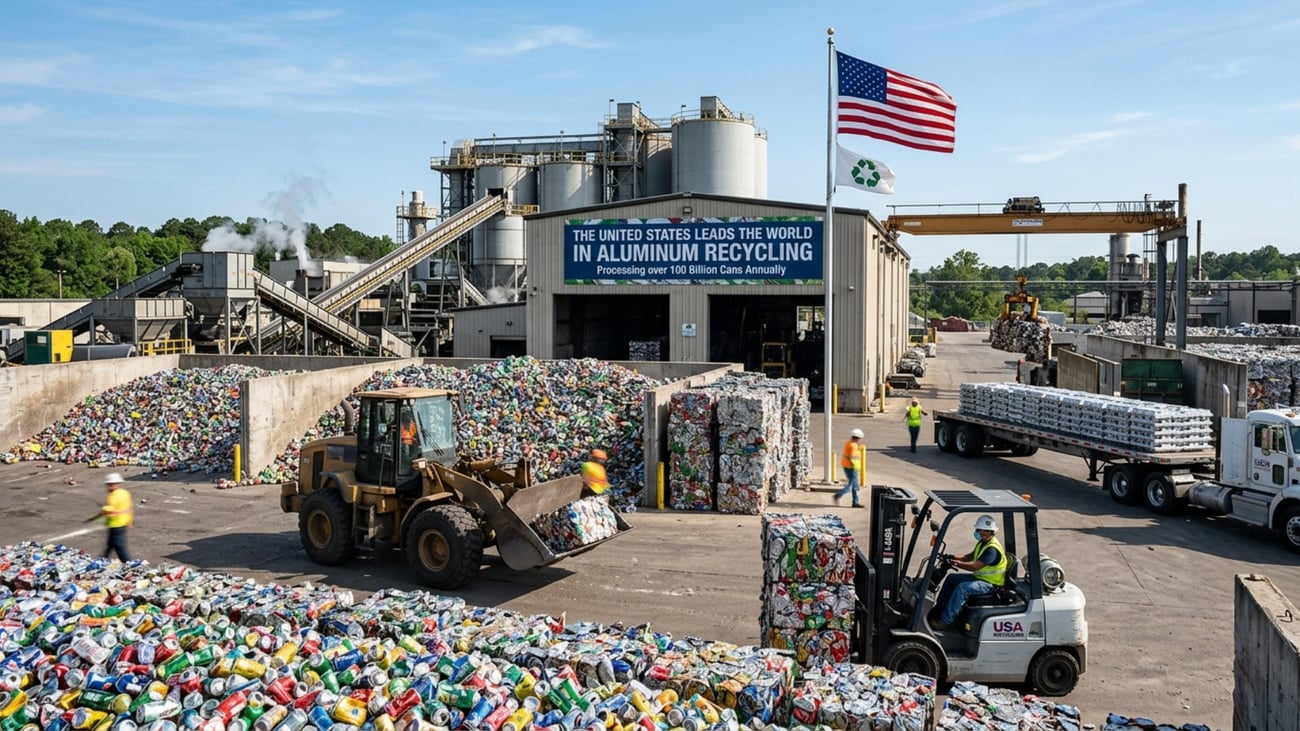 |
| The United States recycles more aluminum than any other country in the world, and the numbers behind that achievement carry lessons well beyond the recycling bin.
Aluminum is one of the few materials that can be recycled indefinitely without losing quality. Recycling a single aluminum can saves enough energy to power a television for three hours. Across the entire US economy, recycling aluminum uses 95% less energy than producing it from raw ore. That efficiency gap is staggering. What makes this relevant to commercial real estate and finance is the underlying principle: preserved value compounds over time. Aluminum that re-enters the supply chain retains nearly all of its original worth. The same logic applies to assets we work with every day. A well-maintained property, a carefully structured loan, or a relationship built over years does not depreciate the way neglected ones do.
The US became number one in aluminum recycling not through a single policy or moment, but through consistent systems, incentives, and discipline applied over decades. In our industry, the sponsors and investors winning long term are doing the same thing: building infrastructure that recovers and redeploys value efficiently, again and again. | |

|  |
|
|
|
|